
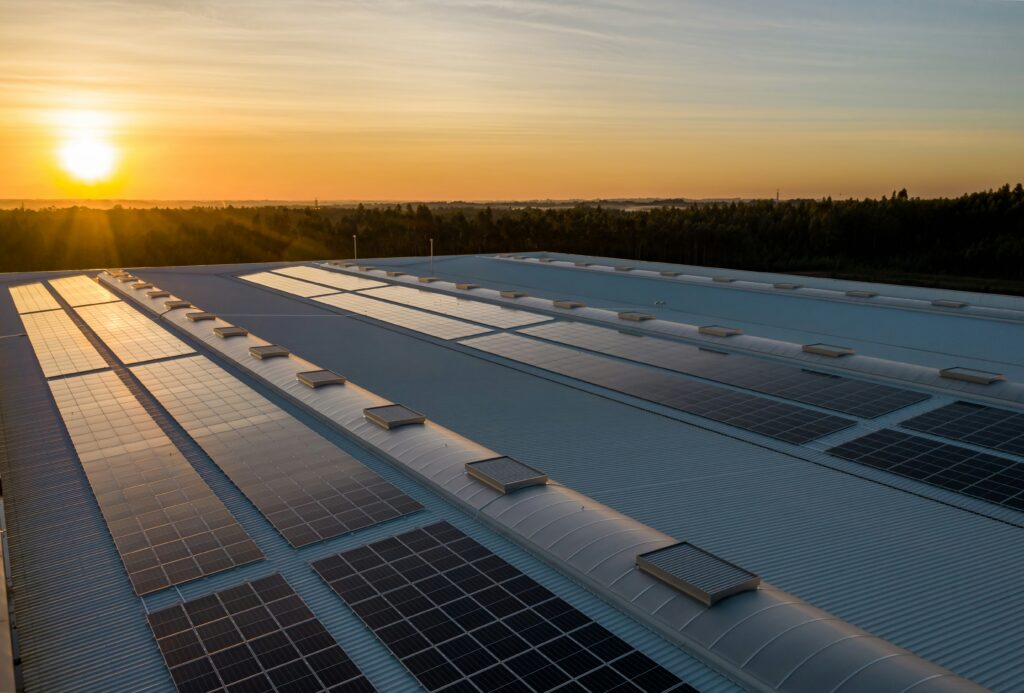
For many warehouses, one of the largest unused assets is directly above the operation. Thousands of square metres of warehouse roof space can sit empty while the business continues buying electricity from the grid to power lighting, machinery, conveyors, refrigeration, IT equipment and vehicle charging.
With rising energy prices putting pressure on operating costs, solar panels for warehouses offer businesses a way to generate more of their own electricity and reduce reliance on grid prices. Warehouses can be particularly well suited to solar because they often combine large roof areas with significant energy consumption during daylight hours.
However, filling every available section of roof with solar panels is not automatically the right answer. Roof condition, energy usage, grid connection capacity, system size and expected self-consumption all need to be considered first.
This guide looks at what warehouse owners, facilities managers and logistics businesses should know before investing in warehouse solar panels.
Why do warehouse solar panels make sense for commercial buildings?
Warehouses often have exactly what a solar PV project needs: a large roof and electricity demand during the working day.
Solar PV systems generate electricity during daylight hours. If that electricity can be used immediately by lighting, automated equipment, refrigeration, offices, plant or electric vehicle infrastructure, the business can buy fewer units of electricity from its supplier.
This is where much of the value of commercial solar comes from.
The UK Warehousing Association has repeatedly highlighted the amount of unused roof space across the logistics sector and the potential for warehouse solar adoption. Large industrial buildings can offer substantial roof area without requiring businesses to use additional land.
There are environmental benefits too. Generating renewable electricity on site can reduce carbon emissions associated with purchased electricity and support wider sustainability targets.
The financial benefits, however, depend heavily on how closely solar generation matches the warehouse’s actual energy demands. A good design starts with consumption data rather than simply asking how many panels will fit.
How many solar panels does a warehouse need?
The number of solar panels a warehouse needs depends mainly on its electricity consumption, usable roof space and the output of each panel. The roof’s orientation, shading, structural capacity and grid connection also affect system size. Rather than filling all available roof space, a commercial solar system should normally be sized around how much solar power the warehouse can use effectively during the day.
There is therefore no meaningful figure for an average warehouse.
Two buildings with identical roof areas can need very different solar systems. A busy distribution centre running conveyors, automated picking equipment and refrigeration throughout the day may use considerably more electricity than a building primarily used for storage.
How do you size solar system capacity correctly?
A useful starting point is 12 months of electricity bills. Half-hourly energy usage data is even more valuable because it shows when electricity is actually being consumed.
An installer can compare this against expected solar generation to determine an appropriate system size.
Imagine two warehouses both have 3,000m² of available roof space. The first has high electricity consumption from 7am until 7pm. The second has relatively low daytime usage and is largely inactive at weekends.
Although the same number of PV solar panels might physically fit on each building, installing the maximum possible solar array on both may not produce the same financial result. The second site could regularly generate surplus electricity that it cannot use directly.
The aim should be maximising self consumption, not simply maximising the panel count.
What do solar panels for warehouse buildings cost?
There is no single answer to what solar panels cost for a warehouse because commercial installations vary considerably in scale and complexity.
The size of the solar panel system has an obvious effect on price, but it is only one part of the calculation. Roof type, structural condition, access, mounting systems, inverter requirements and existing electrical connections can all influence installation costs. Additional work may also be required if the site needs roof repairs, new switchgear, structural strengthening, lifting equipment, battery storage or EV charging.
For this reason, a headline “cost per solar panel” tells a business very little about the likely return.
A better commercial proposal should explain the upfront cost, estimated annual generation, expected self-consumption, likely energy savings and assumptions used to calculate financial savings.
It is sometimes said that solar panels provide free electricity. In practice, the solar generation itself does not carry the same per-unit purchase price as electricity imported from a supplier, but the equipment still has an upfront cost and ongoing ownership considerations. Any financial model should account for these rather than describing solar power as completely free electricity.
Is the warehouse roof suitable for installing solar panels?
Large does not necessarily mean suitable.
Before installing solar panels, the warehouse roof should be checked for its condition, construction, structural capacity, shading and usable area.
Standing seam roofs and metal roofs
Standing seam roofs can often support solar using specialist clamps that attach to the seams. Other metal roofs may need different mounting systems depending on their profile and construction.
The structural assessment should consider the additional loads created by the solar array as well as wind and site conditions.
Flat roofs
Flat roofs are also widely used for commercial solar panel installations. Depending on the building, the system may use ballasted or mechanically fixed mounting equipment.
The layout needs to account for more than panels. Rooflights, vents, drainage, smoke hatches, access routes and plant rooms can all reduce the available roof space.
The survey should also consider safe maintenance access, fire-safety requirements, inverter positions and how the solar installation will interact with the existing building.
Should you repair a warehouse roof before installing solar?
If a roof is approaching the end of its working life, it can make sense to repair or replace it before the solar installation begins.
Otherwise, panels and mounting equipment may later need to be removed so roofing work can take place, adding avoidable time and cost.
Ask the installer how the remaining roof life has been assessed and whether the proposed system will restrict future maintenance access.
How much solar power can a warehouse generate?
Solar PV panels convert sunlight into electricity whenever there is sufficient daylight. They do not need hot weather, which is why solar generation can work across the UK throughout the year.
The amount the panels generate will depend on system size, roof area, orientation, pitch, shading, panel specification, local conditions and system losses. Production will naturally be higher during longer summer daylight hours and lower through winter.
Annual generation is important, but it should not be viewed in isolation. The more useful question is how much of the electricity can be consumed by the warehouse when it is produced.
If a site has significant daytime energy usage, more solar generation can potentially be used directly. If operations reduce substantially at weekends, surplus daytime generation may increase.
This relationship between production and demand is central to making a warehouse solar system work financially.
What happens to excess energy from warehouse solar?
When a solar system produces more electricity than the warehouse needs at that moment, the excess energy can potentially be exported to the grid, stored in a battery or controlled through an export-limitation arrangement.
Selling surplus electricity should not automatically form the core of the business case. In many situations, electricity used on site is more valuable than electricity exported.
Where a business regularly has excess generation, commercial battery storage can be considered as part of the wider energy strategy. Stored power can potentially be used later when the panels are generating less and site demand remains high.
What is G99 and why can it matter for warehouse solar?
Commercial solar projects also need to consider the electricity distribution network.
The Distribution Network Operator, or DNO, manages the local network to which the warehouse is connected. Depending on the proposed generation system, an application may be required before the installation can operate as planned.
For larger generation installations, this can involve the G99 connection process. Applications can require technical information about the generating equipment, system compliance and the proposed connection before commissioning.
This means grid capacity should be investigated early rather than after the panels have been designed.
In some locations, the DNO may place limits on how much power can be exported. Export controls or additional electrical work may therefore form part of the design.
Understanding these requirements early can help avoid delays and give businesses a more realistic view of the grid connection, installation process and expected grid reliance.
Can battery storage and EV charging improve warehouse solar?
Solar does not have to work alone.
A warehouse planning increased electrification may benefit from considering solar, storage and charging requirements together.
Battery storage can potentially capture excess energy generated during the day and make it available later. Whether this works financially depends on battery size, energy usage, tariffs, solar generation and how frequently stored energy can be used.
Electric vehicles can create another useful daytime load. Warehouse fleets, company vehicles, staff cars and material-handling equipment may all increase electricity demand.
Businesses developing electric vehicle infrastructure can therefore assess commercial EV charging solutions alongside their warehouse solar plans.
Where roof capacity is limited, solar carports may also provide another way of generating electricity while making use of parking areas.
The right combination depends on the site. Adding a battery or EV charging simply because it is available does not guarantee better returns.
How can businesses fund a commercial solar installation?
The upfront cost of a commercial solar project is understandably a major consideration.
Some businesses choose to buy the system outright, giving them ownership of the equipment from the outset. Others may look at commercial finance to spread the cost over an agreed term, although financing charges will need to be taken into account when calculating the overall return.
Power Purchase Agreements may provide another route for certain projects. Under this type of arrangement, another party may fund or own the equipment while the occupier purchases the electricity generated under agreed contractual terms.
There is no single funding route that works for every warehouse. Businesses should compare the long-term cost, ownership position, contract terms, maintenance responsibilities and expected energy savings before making a decision.
Any claims about grants, tax treatment or incentives should also be checked against current government and HMRC guidance rather than relying on older commercial solar information.
Do warehouse solar panels need planning permission?
Solar equipment on non-domestic buildings can benefit from permitted development rights in certain circumstances, meaning a full planning application is not always required.
That does not mean every project automatically qualifies. The location of the property, its status, the size and position of the system and other planning restrictions can affect what is permitted.
Planning requirements should therefore be checked for the individual site before work begins.
Landlord approval may also be needed on leased commercial buildings, while insurers and lenders may have their own requirements. These matters are best addressed early rather than after the solar panel installation has already been designed.
When might solar panels not be right for a warehouse?
Solar adoption can make strong commercial sense, but not every warehouse is an ideal candidate.
A roof approaching replacement could make immediate installation impractical, while structural limitations or heavy shading may reduce the usable roof area. Very low daytime energy consumption can also weaken the financial case because a larger proportion of solar generation may need to be exported rather than used on site.
Lease arrangements matter too. A business with only a short period remaining on its lease may need agreement from the landlord or a clear plan for how the investment will be treated.
Electrical infrastructure and local network constraints can also affect what is achievable.
None of these issues automatically rules out installing solar. They simply mean the technical and financial case needs to be assessed properly before committing money.
This is why choosing a solar company based solely on the number of panels quoted or the lowest installation price can be misleading.
What should logistics businesses ask a commercial solar company?
A good proposal should make it easy to understand why a particular solar system has been recommended.
Before agreeing to a solar panel installation, it is worth asking how the system size was calculated, how much generation is expected to be used on site and what will happen to surplus electricity. You should also understand whether the roof condition and structural capacity have been assessed, who will manage the DNO and G99 process and what assumptions sit behind the expected financial savings.
Installation planning matters just as much. Ask how the work will affect warehouse operations, whether electrical shutdowns will be required and what monitoring and maintenance support will be available once the system is commissioned.
For busy logistics businesses, minimal disruption can be as important as generation performance. A well-planned project should identify access arrangements, operational restrictions and electrical work in advance.
A warehouse considering automation, additional refrigeration or EV fleets should also share those plans with the installer. Future energy demands can affect how it makes sense to size solar system capacity today.
You can read more about how UCS Renewables approaches larger projects through our commercial solar solutions.