For many businesses, the roof is one of the largest areas of unused space on the property. At the same time, electricity bills remain a high operating cost and changing energy prices can make long-term budgeting difficult.
Commercial roof solar panels give businesses a way to put that space to work by generating electricity on site. Instead of buying every unit of electricity from the National Grid, a suitable commercial solar PV system can produce power during the working day, helping to reduce energy costs and reliance on grid electricity.
Having a large roof does not automatically mean solar is the right choice, though. Roof condition, structural capacity, energy usage, access, shading and the way your business consumes electricity all influence whether a commercial solar installation makes sense.
This guide explains what UK businesses should consider before installing solar panels, from roof suitability and system sizing to commercial solar panels cost, battery storage and the installation itself.
Can You Install Solar Panels on a Commercial Roof?
Yes. Solar panels can be installed on many commercial roofs, including flat, pitched, profiled metal and standing-seam roofs, provided the structure, roof condition, access and electrical setup are suitable.
A commercial solar survey should assess load capacity, shading, usable roof space, the mounting method and any planning or grid requirements before the final design is agreed. Older roofs, fragile materials or asbestos do not automatically rule solar out, but they may require further assessment or remedial work first.
What Makes Commercial Solar Panels Worth Considering?
If you are asking what makes commercial solar panels worth considering, the biggest advantage is the opportunity to produce some of the electricity your business already needs.
Solar power is generated during daylight hours. This makes solar panels for business particularly relevant to organisations with regular daytime electricity costs, including manufacturers, offices, warehouses, schools, retailers, leisure facilities and other energy-intensive businesses.
When the electricity generated by the solar panel system is used directly on site, the business can purchase less electricity from the grid. Over time, that can contribute to meaningful energy savings and lower exposure to future energy prices.
Commercial solar can also support wider environmental targets. Generating clean energy can reduce the carbon emissions associated with purchased electricity and contribute towards reducing a company’s carbon footprint.
However, the financial case should always be based on the individual property. Commercial solar panel systems perform best when the design reflects how the building actually uses electricity rather than simply fitting as many panels as possible.
Why Your Daytime Electricity Costs Matter
A useful starting point is to look at when your electricity is being consumed.
A manufacturer running machinery between 7am and 5pm may be able to use a large proportion of its solar energy as it is produced. A storage facility with very low daytime demand could have the same roof space but a very different business case.
That is why annual electricity bills alone do not tell the full story. Half-hourly or interval consumption data, where available, can provide a clearer picture of the site’s energy usage.
Understanding your current commercial energy setup helps determine how much electricity could realistically be generated and used on site.
Which Commercial Roof Types Can Support Solar Panels?
Different commercial properties require different approaches to solar installation. The roof construction affects panel positioning, mounting, access and sometimes the number of panels that can be installed.
Flat Commercial Roofs
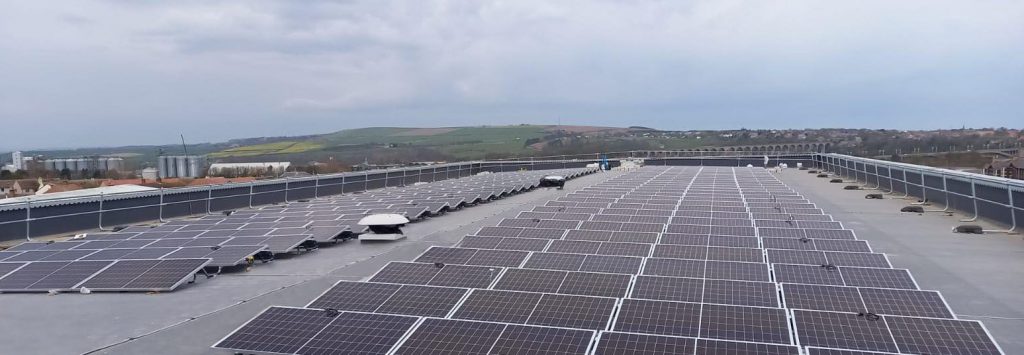
Flat roofs are common on warehouses, offices, retail units and industrial buildings. Solar panels are usually installed on mounting systems that position the modules at an appropriate angle.
A flat roof can offer flexibility over panel orientation, but the design still needs to account for wind loading, drainage, roof edges, access routes and existing equipment.
An east-west layout may sometimes allow more panels to fit within the available roof space and can spread energy generation across a greater proportion of the day.
Profiled Metal and Standing-Seam Roofs
Many industrial buildings and warehouses have profiled metal or standing-seam roofing.
These roofs can often accommodate commercial solar panels using mounting equipment suited to the particular roof covering. The condition of the sheets, fixings and underlying structure still needs checking before the solar PV installation is designed.
Pitched Commercial Roofs
Solar PV can also be fitted to suitable pitched commercial roofs. Orientation, pitch and shading will influence the energy produced, while safe access needs to be considered during both installation and future maintenance.
A roof does not need to face perfectly south for solar to be viable. The expected electricity generation should be modelled for the actual building rather than ruled in or out based on orientation alone.
What About Older, Fragile or Asbestos-Containing Roofs?
Older commercial roofs require particular care.
If a roof is approaching the end of its working life, carrying out major roofing work before installing solar panels may make more sense than removing the solar system later to complete repairs.
Fragile materials and asbestos-containing products also require specialist assessment. Their presence does not provide enough information on its own to decide whether you can install solar. The condition of the roof, safe working requirements and any necessary remediation need to be established first.
This is one reason a proper commercial solar panel installation should begin with surveys and technical assessment rather than a quotation based only on satellite imagery.
For businesses ready to investigate their building in more detail, our commercial solar solutions include site assessment, system design and installation based around the property and its electricity requirements.
How Much Roof Space Does a Commercial Solar PV System Need?
There is no fixed amount of roof space required because the answer depends on the capacity of the proposed commercial solar PV system and the panels being used.
More importantly, total roof area is not the same as usable roof area.
Rooflights, vents, HVAC equipment, parapets, shaded areas, access routes and maintenance zones can all reduce the space available for solar panels. Fire safety and safe access requirements also need to form part of the layout.
Where roof space is limited, panel efficiency may become more important. Where a business owns surrounding land, ground space may provide another option for certain solar systems, subject to site constraints and planning requirements.
The aim should be to install solar at a scale that works for the property and its energy demand, not to cover every available square metre simply because it is there.
How Much Electricity Can Commercial Solar Panels Generate?
The amount of electricity generated depends on system size, location, panel orientation, pitch, shading and system performance.
For a business, another important figure is how much energy can actually be used on site.
Imagine two warehouses with identical commercial solar power systems. Warehouse A operates machinery throughout the working day. Warehouse B mainly stores goods and uses relatively little electricity.
Both may produce similar amounts of solar energy, but Warehouse A could consume a greater proportion of the energy generated directly. That can change the financial value of the project because less electricity needs to be purchased at normal business electricity costs.
Good system design therefore considers both electricity generation and consumption.
When choosing solar panels and deciding on capacity, ask how much energy the proposed system is expected to produce, how much the business can use and what is likely to happen to any excess energy.
How Is a Commercial Solar Panel System Sized?
Sizing begins with data.
Electricity consumption, operating hours, roof dimensions and future energy requirements should all be considered before deciding how many panels to install.
For some UK businesses, the priority may be reducing high electricity costs. Others may be planning additional electric machinery, heat pumps or EV charging and expect their future energy demand to increase.
The proposed solar PV system should account for these changes where they can be reasonably predicted.
Oversizing without considering consumption can result in more excess electricity being exported than expected. Undersizing may mean usable roof capacity is left unused even though the business has enough daytime demand to benefit from greater renewable energy generation.
The right answer sits between those extremes and depends on the site’s energy strategy.
What Does a Commercial Solar Panel Installation Involve?
A commercial solar panel installation normally begins well before anyone arrives on the roof.
The first stage is understanding the building, electrical infrastructure and business energy profile. A site assessment can then establish roof condition, shading, access, usable space and any factors that could affect the solar installation.
From there, the commercial solar PV design can be developed around expected energy generation and on-site consumption.
Structural requirements should be checked before installation begins. Grid connection requirements also need to be considered, particularly on larger systems or where substantial export capacity is proposed.
Installation planning should consider how work will affect normal operations. Access arrangements, delivery areas, working hours and any necessary shutdowns can often be discussed in advance so disruption is kept under control.
What Should You Have Ready Before Speaking to Solar Installers?
You do not need to know exactly what solar panel system you want before requesting an assessment. In fact, choosing a system before understanding the site can put the process in the wrong order.
Having some basic information available can make the initial assessment more useful:
- Recent electricity bills and, where available, half-hourly consumption data
- Normal operating hours and any seasonal changes in electricity use
- Roof plans, building drawings or structural information if available
- Details of roof repairs, refurbishment or planned replacement
- Information about existing electrical equipment and supply capacity
- Planned increases in demand, such as new machinery, heating or EV charging
- Your priorities, whether these are lower operating costs, energy security, carbon reduction or a mixture of all three
A good solar installer should then be able to explain how those factors affect the design rather than simply recommending a predetermined package.
How Much Do Commercial Solar Panels Cost?
There is no single answer to commercial solar panel costs because commercial projects vary considerably.
System capacity is an obvious factor, but it is not the only one. Roof type, structural requirements, access equipment, cable routes, electrical work, grid requirements and the complexity of the installation can all affect price.
For example, two commercial properties might require a similar amount of commercial solar PV, but one may have unobstructed roof access and modern electrical infrastructure while the other requires structural work and electrical upgrades.
Funding arrangements can also affect how a project is approached. Some businesses purchase systems outright, while others investigate finance or power purchase agreements.
Occasionally, business support programmes may advertise grants or interest-free loans for energy-efficient technologies. Availability and eligibility change, so funding should always be checked against the current scheme rather than built into a project on the assumption that support will be available.
What Happens to Excess Electricity?
When commercial solar panels generate more electricity than the building is using, the excess electricity has to go somewhere.
Depending on the installation, it may be exported to the local energy network or stored for later use.
The Smart Export Guarantee, often shortened to SEG, provides a route for eligible small-scale renewable generators to receive payment from participating suppliers for qualifying electricity exported to the National Grid.
Businesses considering export should check current eligibility, metering and tariff requirements. Ofgem’s Smart Export Guarantee guidance provides the current regulatory information.
For many commercial properties, however, the strongest financial benefit still comes from using as much of the electricity generated on site as is practical.
Should You Add Battery Storage to Commercial Solar?
Battery storage can retain some excess solar electricity and make that stored energy available later.
Whether a solar battery makes financial sense depends on how the business consumes power. A site that already uses most of its solar generation as it is produced may have a different case for storage than a property that regularly produces excess energy during quieter periods.
Battery systems can also form part of a broader approach to energy security and future energy planning.
Rather than assuming every commercial solar installation needs a battery, it is better to model solar generation and consumption first. Our guide to commercial battery storage explains how storage can work alongside renewable energy systems.
Can Solar Power Support Business EV Charging?
It can.
Businesses adding electric cars or vans may see electricity demand rise, which makes future energy planning increasingly important.
Solar production and vehicle charging will not always occur at exactly the same time, but considering both technologies together can help determine future electrical requirements and how more of your own power could be used on site.
If electric vehicles form part of your plans, our EV charging solutions provide more information about workplace charging infrastructure.
Choosing Commercial Solar Installers
Commercial solar involves more than fitting panels to a roof. Design quality, electrical work, structural considerations, grid requirements and long-term system performance all matter.
When comparing solar installers, ask who will assess the roof and electricity demand, what performance assumptions are being used and what happens once the system is operating.
UCS Renewables is MCS certified and works to recognised renewable energy and quality standards. Our experience includes renewable energy projects across private and public sector environments, giving our team an understanding of the practical considerations that can accompany larger commercial sites.
That experience is useful, but the recommendation should still come back to your building. A suitable commercial solar solution is one based on the roof, the electricity profile and what the organisation wants to achieve.
Making Commercial Roof Solar Panels Work for Your Business
Commercial roof solar panels can make productive use of space that many businesses already own, helping to generate electricity, reduce electricity bills and support a longer-term move towards renewable energy.
The strongest projects are not based on roof size alone.
Roof condition, structural capacity, daytime demand, energy prices, expected electricity generation, grid requirements and future plans all need to be understood before commercial solar panels are specified.
If you are considering installing solar panels on a commercial property, the next useful step is to establish whether the roof and energy profile support a viable project.
UCS Renewables can assess your roof space, electricity use and current commercial energy setup before recommending an appropriate commercial solar PV system. Contact our team to arrange a site assessment and find out what generating electricity on site could mean for your business.